
Share Lillie Vernal Scobie's obituary with others.
Invite friends and family to read the obituary and add memories.
Stay updated
We'll notify you when service details or new memories are added.
You're now following this obituary
We'll email you when there are updates.
Select your format and elements to print

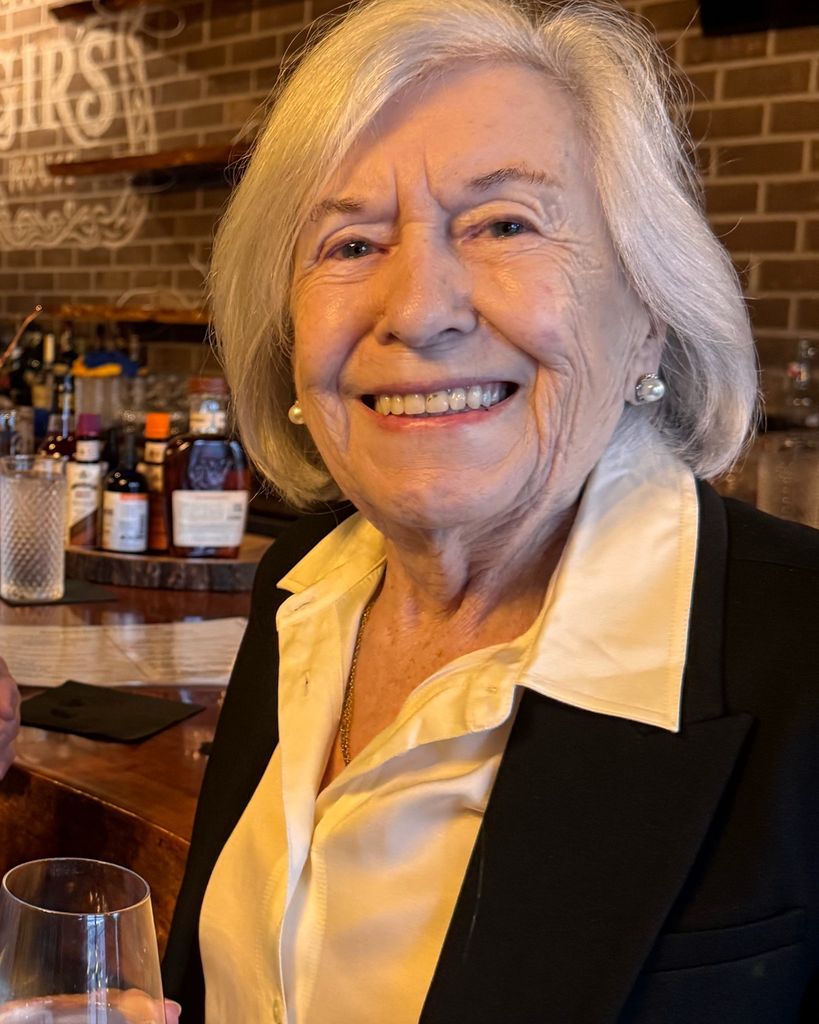
Lillie Vernal Scobie
Apr 9, 1945 — Sep 7, 2026
Share Lillie Vernal Scobie's obituary with others.
Invite friends and family to read the obituary and add memories.
Stay updated
We'll notify you when service details or new memories are added.
You're now following this obituary
We'll email you when there are updates.
Select your format and elements to print




Lillie Vernal Scobie was a woman of uncommon beauty, quick wit, quiet courage and magnificent good humour. She could set a beautiful table, outplay almost anyone at golf, silence nonsense with a single look and make hardship feel like an adventure. She was elegant without vanity, formidable without cruelty, and happiest when the people she loved were gathered around her.
My mother was born to Margaret and Alec Sands on April 9, 1945, at home on Grange Avenue in Falkirk, close to the ironworks and coke ovens where her daddy worked during the war. Seven years younger than her brother, she was simply named “ Baby Sands” until the family felt confident she intended to stay; only then was she named Lillie Vernal, names chosen by the grandmother she adored. That particular spelling caused her no end of trouble, including a belting from an overzealous teacher for having the audacity to correct the more conventional “Lily.” Her childhood was shaped by the aftermath of war: the family was respectably impoverished, deeply religious, and allowed only the rarest rationed sweeties. She did the shopping because her mother often had no shoes in which to go outside.
She loved her granny Susan, whose invalid bed was a warm haven where she learned to read and knit, and dream. Her most prized childhood possession was an adult library card- she earned another belting for daring to say she was allowed to have more than one book, a privilege her elder brother had never been afforded. The librarian gladly came to her defense and made her a lifelong fan of the public library system, and books. All books, every book. As children my sister and I could read anything we wanted, from any section of the library, which caused no end of interesting conversations with other parents and less liberal librarians.
At seven, life dealt her two blows. Her granny died, and her mother had another baby and became terribly ill, leaving my mother to assume the work of the house. She did all of it, the cleaning, cooking, laundry when she was too small to reach the washing line without a chair. Her early life’s proudest achievement was being told she put out a lovely wash by one of the neighbors.
As an older child, her parents went into service in Bearsden. Her father was the chauffeur and gardener, and her mother the housekeeper and cook. The Macfarlane’s house was a palace, and my mother loved the china and linen and flowers, and the polished wood of the house. She attended Bearsden Academy on a scholarship. She was a prefect, and loved her school days, stealing away to smoke cigarettes behind the bike shed, passing dog- eared copies of Peyton Place around the Prefect’s room. She was wickedly intelligent and funny, athletic and competitive. She loved hockey and her friends, and her dad hoped she might get a sensible civil service job and be safe. My mum had other ideas; she volunteered at Canniesburn hospital, and fell in love with the profession of nursing, which was not popular with her parents.
While still at school, she met a Milngavie boy at youth group. Family legend holds that he saw her and promptly announced that he would marry her. She was less immediately convinced: he belonged to the wildly permissive Church of Scotland and was rumoured to have designs on the minister’s daughter. Undeterred, he courted her with long walks and longer letters, ping-pong and badminton, fishing and golf, and raucous games of cribbage with his family, whose fondness for drink was matched only by their indifference to the rules. He was her first and only love.
Without the knowledge or support of either her parents or her boyfriend, she applied to the Edinburgh Royal College of Nursing and was accepted. All three were appalled, but she held firm and left in 1963 for what she would remember as some of the happiest days of her youth. She lived almost like a nun in the nurses’ home on Chalmers Street, worked her fingers to the bone and formed lifelong friendships with her colleagues. Weekends were spent on buses to and from Bearsden or at highly illicit parties with her friends. My dad was at college and apprenticed at John Brown’s shipyard in Clydebank. Their letters reveal a long and tender courtship conducted across long separations: a shared future planned on paper, punctuated by visits to Blackford and walks carefully chaperoned by grandparents and cousins. He taught her to fish; she promptly outfished him, establishing a pattern that continued through badminton, golf and crosswords.
When they finally became engaged in 1965, he used up all his money on her secondhand ring, so she had to buy them chips and his bus ticket home. They married in 1966. Too poor to buy a gown, she made a dress from silk she carried home in a bolt from Jenner’s department store. They honeymooned in London and came back to a 9th floor flat in Blair House in Cumbernauld, where for nine months they entertained friends and built a life of work and wine and cheese parties, music and love, punctuated by unannounced Sunday morning visits from the parents.
In 1967, their first child arrived. Hidden under a nurse’s apron for as long as was possible, this child ended her nursing career for the time being and she settled in to being a mum. Not long after, the first of many adventures presented itself, and she found herself moving to Franco’s Spain in a Mini Cooper with a carrycot wedged in the back seat, and the doors lined with pound notes. Left alone for long periods, she marshalled her courage and walked all over Zaragoza, made amazing friends and taught herself enough Spanish to get by. They loved their time in Spain, and when it was over, journeyed back home to Glasgow.
Her husband worked on ships, frequently leaving her alone for long periods, so she became even more resourceful and independent. In 1971, he got stuck on a tanker in the Suez Canal, leaving her alone with a newborn and a toddler, and a dilapidated terraced house to repair. Their marriage almost ended when he called her from the ship. Not aware of the existence of ship to shore radio, she was convinced he was lying, but they survived and he returned to a wife, a newly painted house and thriving children.
They spent most of the seventies in the house on Glen Carron, delighting in their neighbours, playing sports at the John Wright Sports Centre and Torrance House Golf Course, and working for the Blacklaw PTA. After an enormous argument, she persuaded my father that sending her back to work had been his idea all along. She worked weekend nights at Hairmyres Hospital, then came home and launched straight into housework, walking to swimming lessons or DIY projects as though sleep were an affectation. She loved nursing and excelled at it, rising to Night Sister. She also loved cooking and dinner parties, recreating Delia Smith recipes on a three-ring Baby Belling while dressed in a long skirt over hot pants, Simon and Garfunkel playing on the stereo. Her children watched in awe as she emerged glamorously from the kitchen or left for dinner dances on her husband’s arm. Family holidays were spent in decidedly less glamorous places—Arran, Carrick and Southend—with raincoats, sun cream, fishing rods and books and her firm declaration that, for one week, she would be neither cook nor parent.
Things were difficult in Scotland in the late seventies, and like many of their neighbours, they fell on hard times. She approached adversity as she approached everything else: as a project requiring ingenuity and a good team. One Christmas, when my dad’s company had no work, she marshalled pipefitters and welders into service as elves, producing dozens of dolls’ houses and go-karts. Their recipients marveled that the dolls’ houses had exactly the same carpets and curtains as their newly shortened ones at home, while wondering why so many old bicycle frames had appeared in the staff room. In 1979, like many of their generation, the family emigrated to the United States. Heartbroken to leave her family, friends and the home she had made with her own hands, she nevertheless made the upheaval feel like an adventure to her children. She never let them see what it cost her to sell nearly everything they owned and cross an ocean in an age before social media and inexpensive long-distance calls.
Once in Texas, she settled into being a mum and wife. She and my dad were vehemently opposed to latch key children, and childhood work, and as a result, my sister and I were spared from most chores and driven from activity to activity without complaint. My mother was great fun- she had her toe broken in an enthusiastic Indian leg wrestling bout, participated blindly in toilet papering houses, and tried without much success to keep us on the straight and narrow. We rewarded her devotion with the typical venom of teenage girls. Having always wanted a sister, she didn’t understand why her daughters were locked in combat, small pugnacious duplicates of her husband, looking and behaving nothing like her.
She became adept at scoring softball, and counting out dance routines, administering Ogilvie home perms and trying not to kill her cubs who richly deserved it. She and her husband never stopped playing and laughing with each other; she often reminded others who were parents that they were spouses first, and would be spouses long after their children left. There was never any doubt whose woman she was.
She was strict about certain matters—makeup, holes in jeans, concerts, boys, tarantulas in the bedrooms, and sneaking out—but she was also an unwavering advocate for women understanding and having authority over their own bodies. More than one lesson in biology and reproductive rights was delivered from the driver’s seat of the Delta 88. She was quiet, but only the very brave mistook that for weakness. She could say everything with one look, and wielded good manners and civility like a broadsword.
Once her girls were in college, she went to work at Foley’s, outfitting the newly engaged and the recently divorced with household goods and china. Between shifts, she travelled home to Scotland to care for her ageing parents-in-law and regularly beat her husband soundly at golf. They belonged to Tomball Country Club and loved playing there until his job took them to Chicago. They delighted in hosting visitors from Scotland, showing off Texas as though it had been created expressly for their entertainment. She treated each move as another adventure, never complaining when Chicago was followed by Rhode Island. She threw herself into golf wherever they went, but was not truly happy until they returned to Texas and she could devote herself, with characteristic enthusiasm, to being a grandmother.
She was a devoted and delighted grandmother to five- Lennox, Nathan, Iain, Gavin and Kylie. Never happier than when she was caring for people she loved, she enjoyed every minute of her grandkids, enduring endless games with Lego, showings of Polar Express, Thomas the Tank Engine and Cars. They were the joy of her life.
When her husband died in 2008, she lost her soul mate and focused her energy on her younger daughter and her beloved younger grandkids. As they grew and needed her less, she found PBGN, where she made friends and lit her spark again. She really enjoyed her time with her friends, playing and lunching and travelling to tournaments. She was a really good golfer, with a straight down the middle drive, still playing with a cut down 5 wood that belonged to her husband. She could never bring herself to replace it, even with her winnings at the pro shop.
She travelled to Washington and all over the world with her elder daughter, exploring everything with a wicked sense of humor and a deep curiosity that took her from Vancouver, to the dens of iniquity on Bourbon Street and the baths of Budapest, where she broke her elbow but refused medical care until she could get back home. She talked her way into a famous nightclub in Vegas by batting her eyelashes at a doorman, and got her daughter out of numerous fast driving awards on the way to California by flirting with the troopers. She saw Kilauea erupt and developed a fondness for flinty white wine which she enjoyed whenever possible, especially while outscoring others at trivia.
She moved to Washington permanently in 2024, when her health meant she needed more company. Over time, she and her elder daughter came to understand and admire one another better, although she never fully understood powerlifting singlets or the chronic swearing and lack of lipstick. She read voraciously, indulged in shopping for beautiful clothes, cuddled her dogs, and completed jigsaw puzzles with glee. She developed a Washingtonian appreciation for decent coffee, pored over travel magazines to find cities and beach resorts to visit, and developed an appreciation for musical theatre, fine art and marine life. She expanded her television horizons slightly beyond PBS to shows about gay hockey players and loved planning and supervising dinner parties and renovation projects. She adored her son in law, who made yogurt for her and kept her supplied with home made bread and jam and tea and ice cream. Her last vacation was to San Diego, to see her eldest grandchild, visit the zoo and check off eating at a Michelin starred restaurant.
She missed her old friends dreadfully after moving to Washington, but she made new ones—most of them forty years her junior. Few things pleased her more than a house full of people and the chance to set a beautiful table for them.
She never complained, even when she was in terrible pain; she was always more comfortable as the helper than the helped. Her standard hospital bag contained lipstick, books, reading glasses and respectable knickers. When she came home from the hospital for the final time, she wanted only for people to visit and be happy. And so they did, eating and drinking around a table she had set. She slipped away on September 7, 2026, after a brief and brutal illness, holding her husband’s letters and held in the arms of her elder daughter. The world lost a great lady: stylish, steadfast, wickedly funny and loved beyond measure.
To laugh often and much.
to win the respect of intelligent people
and the affection of children;
to earn the appreciation of honest critics
and endure the betrayal of false friends;
to appreciate beauty;
to find the best in others;
to leave the world a bit better
whether by a healthy child, a garden patch,
or a redeemed social condition;
to know that one life has breathed easier
because you lived here.
This is to have succeeded.
Ralph Waldo Emerson
Arrangements entrusted to Cook Family Funeral Home of Bainbridge Island, WA.
To send flowers with our preferred florist or plant a memorial tree, please visit our flower store.
Guestbook
Visits: 360
This site is protected by reCAPTCHA and the
Google Privacy Policy and Terms of Service apply.
Service map data © OpenStreetMap contributors